
Your step-by-step routine
1. 1. Mountain and 2. Upward salute
3-minute station: mountain for 30 seconds, four slow arm raises over 60 seconds, mountain for 30 seconds, then 60 seconds to rest and set up.
- Stand with feet about hip-width apart and knees unlocked. Let your arms hang and notice pressure through the heels and the bases of the big and little toes.
- For mountain, keep your head comfortably above your ribs rather than pulling your shoulders back hard. Take ordinary, unforced breaths.
- For upward salute, sweep your arms outward and upward only as far as comfortable. Lower them slowly; one raise and lower is one repetition.
Make it easier: Practice seated on the front half of a sturdy chair, or raise one arm at a time below shoulder height.
Watch for: Do not lean backward to get the arms higher. Keep your gaze level if looking up feels unsteady.
2. 3. Chair pose and 4. Supported standing forward fold
3-minute station: three 15-second chair holds with 15-second standing rests, a 30-second supported fold, and 60 seconds for transitions.
- Stand in front of the secured chair. Bend your knees slightly and send your hips backward as if beginning to sit, keeping both heels down.
- Hold the shallow chair shape with hands at your hips, then stand fully between holds. You do not need a low squat.
- For the fold, put your hands on the chair back, soften your knees and hinge at your hips. Keep your head in line with your trunk and stop before your back rounds deeply.
Make it easier: Sit down completely for chair pose, or use only a small hip hinge for the fold.
Watch for: These are supported or loaded positions, not an invitation to hang from the lower back. Avoid locking the knees.
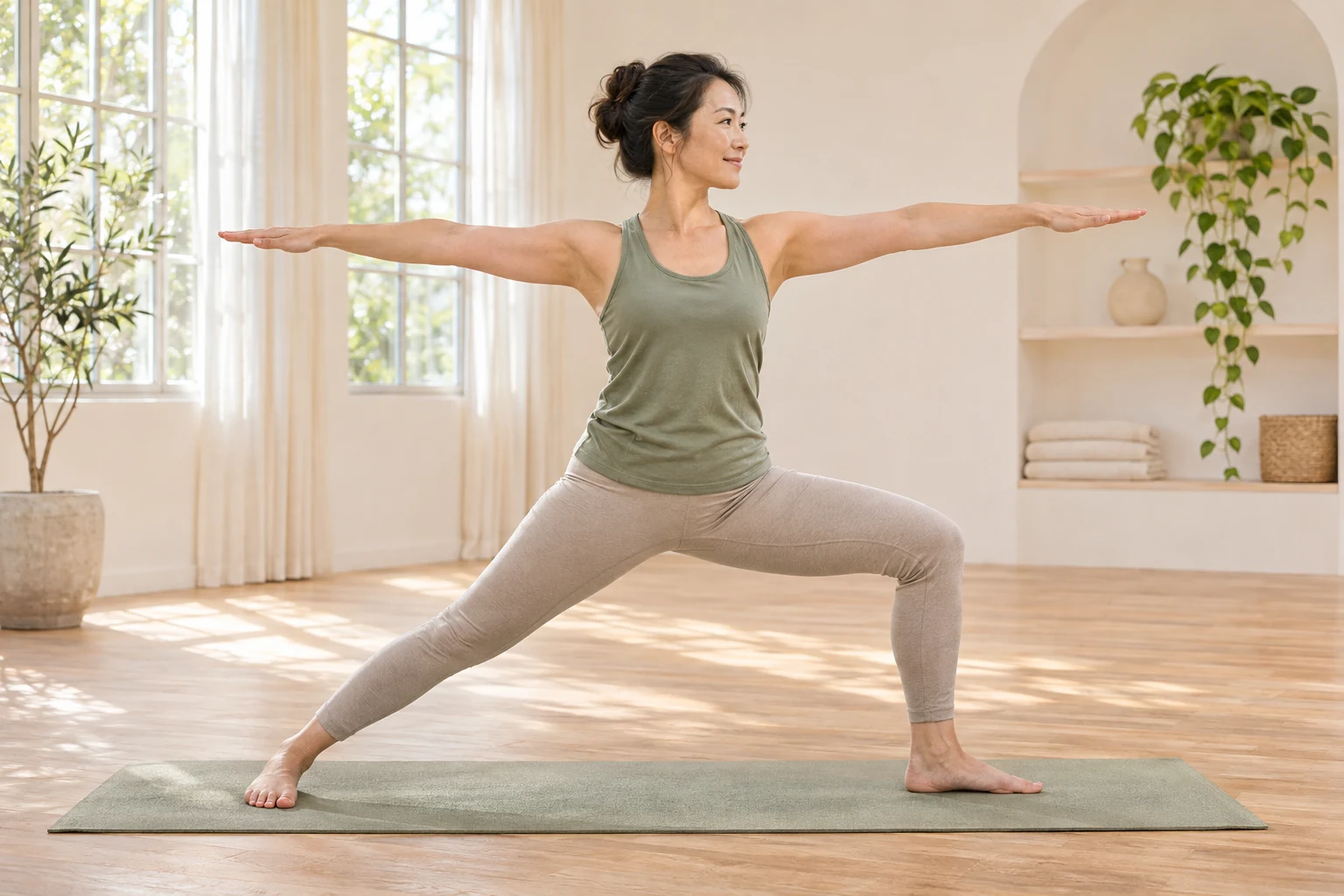
3. 5. Warrior II and 6. Supported tree
3-minute station: warrior II for 20 seconds per side, supported tree for 20 seconds per side, with 100 seconds total for rests and foot changes.
- Take a modest wide stance. Turn the right foot outward and the left foot slightly inward; bend the right knee in the direction of the middle toes.
- Keep the bend shallow and extend the arms comfortably for warrior II. Straighten, reset your feet and repeat facing the other direction.
- For tree, stand beside the chair with one hand supported. Keep one foot grounded and place the other toes on the floor with its heel against the standing ankle; switch sides.
Make it easier: Keep hands on hips in warrior II and both sets of toes on the floor in tree.
Watch for: Never press a lifted foot into the side of the knee. Narrow or shorten the stance if your footing feels uncertain.
4. 7. Tabletop and 8. Cat
3-minute station: tabletop for 30 seconds, five gentle cat-to-neutral repetitions over 60 seconds, then 90 seconds for rest and the floor transition.
- Lower to the mat using the chair if helpful. Set hands beneath shoulders and knees beneath hips, with a blanket under the knees if wanted.
- In tabletop, spread your fingers and gently press the floor away. Keep elbows soft and look at the mat.
- For cat, breathe out and round the back a little, letting your head follow. Return to a comfortable neutral spine rather than forcing a deep arch.
Make it easier: Perform the rounding motion seated, with hands resting on thighs; avoid hand loading if wrists object.
Watch for: Tabletop loads wrists and shoulders. Stop for joint pain, numbness or tingling rather than shifting all your weight to one hand.
5. 9. Child's pose and 10. Sphinx
3-minute station: child's pose for 30 seconds, two 20-second sphinx holds with a 20-second rest, and 90 seconds to change position and settle.
- From kneeling, move your hips back only as far as comfortable for child's pose. Rest your forearms on the mat or a firm cushion.
- Come forward, then lower onto your front without rushing. Place forearms on the mat, with elbows slightly ahead of shoulders.
- For sphinx, gently lift the upper chest while keeping the pelvis down. Return your chest to the mat between holds.
Make it easier: Replace child's pose with a seated forward lean onto a table; replace sphinx with quiet lying on your side.
Watch for: Skip deep knee bending or back extension when uncomfortable. A compressed or pinching sensation is a reason to leave the shape.
6. 11. Seated staff and 12. Constructive rest
3-minute station: staff for two 30-second holds with a 30-second reset, constructive rest for 60 seconds, and 30 seconds to transition.
- Sit on a folded blanket with legs forward and knees slightly bent. Place hands beside your hips or on blocks for staff.
- Lengthen upward without forcing the legs straight or pushing down hard through your hands. Relax, adjust the seat and repeat.
- Roll onto your side and then onto your back. Bend your knees, place feet on the floor and let your arms rest beside you for constructive rest.
Make it easier: Practice staff sitting on a chair with feet grounded. Remain seated for the rest position if getting to the floor is difficult.
Watch for: Do not force an upright seat by straining your lower back. Add support or bend the knees more.
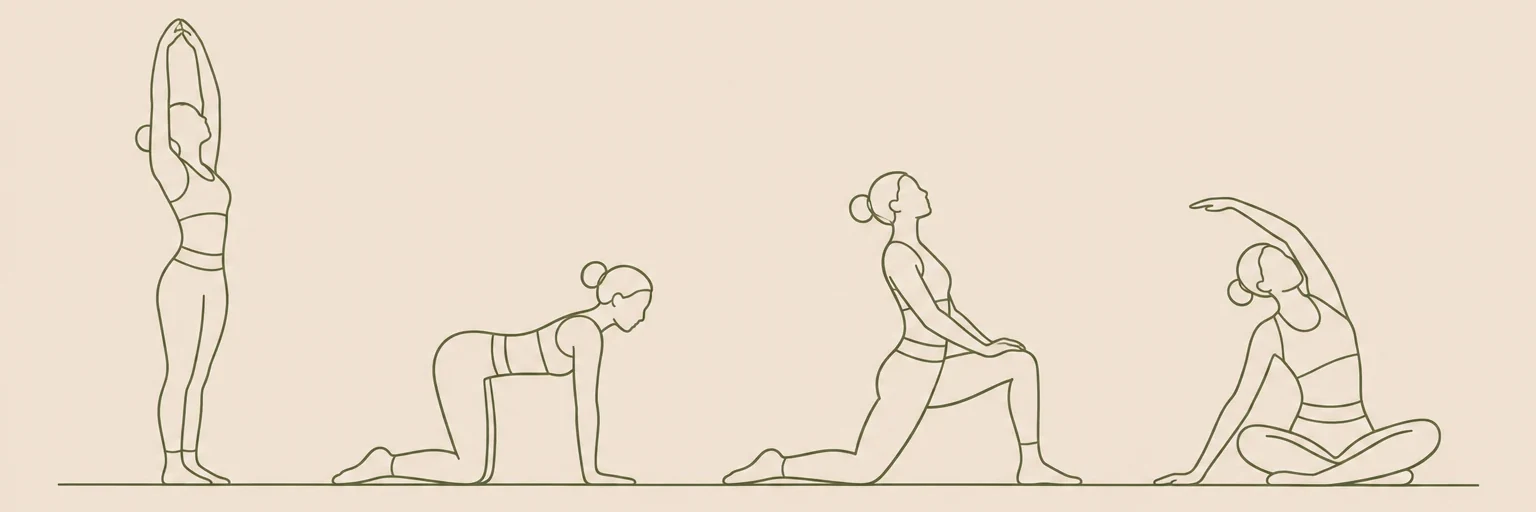
Illustrations are for orientation, not a depth or flexibility target.
How to use the 24-minute sampler
Read the instructions before starting the clock. Warm up for four minutes: walk gently for two minutes, roll the shoulders for one minute, then alternate easy heel lifts and small knee bends for one minute. Each three-minute station includes its own rests and transition allowance. Finish with two additional minutes seated or lying comfortably, then get up slowly.
The twelve named poses are grouped into six stations so you can learn changes in position without constant rushing. You can stop after any station. If a transition takes longer, extend the session rather than shortening a rest or moving faster. Browse the yoga practice hub for other ways to organize a short session.
Which poses are stretches and which ask for effort?
Chair, warrior II and tabletop ask muscles to support your body weight. Supported tree also asks for balance. A mild muscular effort is different from the gentle pulling sensation you might notice in a supported fold or child's pose. None of the holds should require bracing your breath or enduring joint discomfort.
Begin with one round on two or three nonconsecutive days a week if that fits comfortably. Repeat the same version before adding hold time. For less standing and no floor transfers, choose chair yoga for beginners. For a smaller first-session menu, try yoga for complete beginners.
When to modify or stop
Keep breathing normally. Stop a pose for sharp pain, pinching, tingling, numbness or dizziness. Stop the session for chest discomfort or unusual breathlessness and seek appropriate help. If an injury, recent operation, pregnancy or health condition affects activity, ask a suitable healthcare professional about individual restrictions before beginning. This general movement guide does not assess whether a particular pose suits your circumstances.
Frequently asked questions
Must I do all twelve poses in one session?
No. Learn one or two pairs first and leave out positions that do not suit you. The 24-minute schedule describes the complete sampler, not a minimum requirement.
Do I have to touch my toes?
No. The supported forward fold uses a chair so your hands do not need to approach the floor. Soft knees and a comfortable hip hinge matter more than reach.
Should I hold my breath during balance poses?
No. Use the chair, keep your toes down and breathe normally. If you cannot breathe comfortably, reduce the challenge or return to standing on both feet.
Keep exploring yoga
Find more in our yoga guides, or make the timing your own with the routine builder.
Sources & context
These references inform general movement and safety guidance. The sequence and timings are editorial suggestions, not an individually prescribed program.